


There are films that end when the credits roll, and there are films that do not end at all, that simply recede into the far rooms of the mind and wait there, patiently, for the right ache to summon them back. Masaan belongs to the second category. I first watched it years ago, in a season of my life when I was still deciding which version of myself I wanted to become, and it has returned to me since in the most unlikely moments: while watching smoke rise from a factory chimney in the English Midlands, while standing on a bridge over a river that was not the Ganga but somehow rhymed with it, while listening to a friend describe the particular loneliness of wanting a life her family could not imagine for her. This is what certain stories do. They do not entertain us so much as they lend us a vocabulary for feelings we had been carrying wordlessly, sometimes for years, and once we have the vocabulary, we cannot stop noticing how much of our lives were waiting to be named.
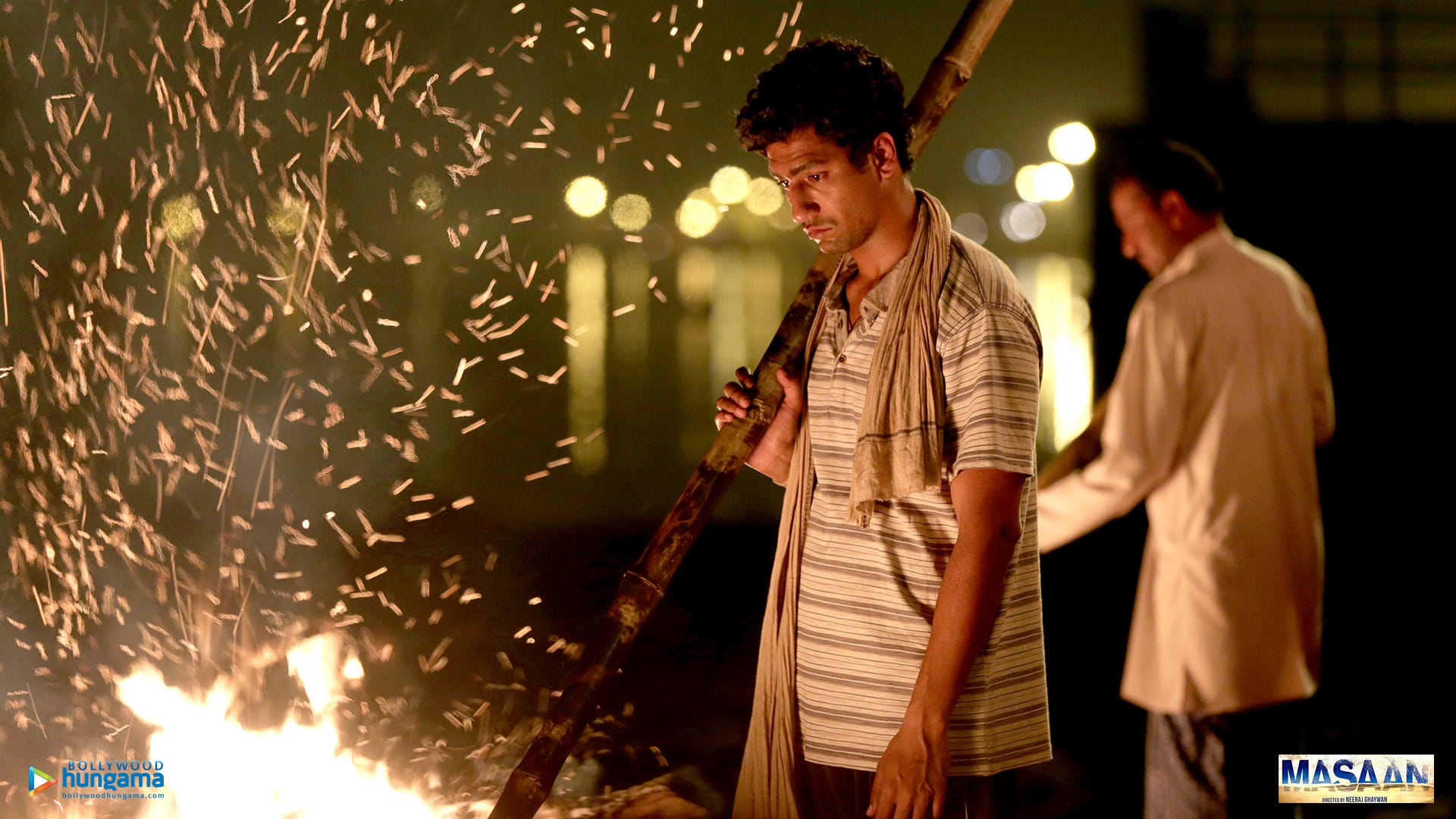
Masaan is often described, reasonably enough, as a film about caste and about the death of a young woman’s dignity in the eyes of a society that polices desire more fiercely than it polices cruelty. It is also, just as reasonably, described as a film about grief, about a father losing his son to the river he has spent his life cremating strangers beside. But to describe it only this way is to mistake its surface for its depth. What Masaan is actually interested in, I have come to think, is not death at all. It is survival. Every serious story about death, if it is honest, is really asking the harder question: how does one go on living the next morning, and the morning after that, when something essential has been taken and cannot be returned? The film’s characters do not get to grieve in the abstract, cinematic way that grief is often portrayed, as a beautiful sorrow that ennobles a person and then passes. Their grief has to share space with rent, with exams, with the humiliating machinery of small-town respectability, with the simple fact that the world does not pause for anyone’s devastation. This, I would argue, is closer to how grief actually behaves. It does not arrive as an event with a beginning and an end. It arrives as a permanent revision of what is now possible.
This is worth sitting with, because we tend to think of grief primarily as the loss of a person, when in fact it is more accurately the loss of a future that person made imaginable. When someone we love dies, or when a love we depended on collapses, or when a mistake forecloses a path we had quietly been walking toward for years, what breaks is not only the past we shared with them but the specific tomorrow we had built in our minds using them as a structural beam. Simone Weil wrote, in her meditations on affliction, that suffering is not simply pain but the sense of being reduced, of having something essential drained out of a person’s sense of what they are permitted to become. That is the register in which Masaan operates. Its characters are not merely bereaved. They are made smaller by what has happened to them, made to feel that certain futures are no longer available to people like them, and the film’s real subject is the slow, unglamorous labour of refusing that reduction.
Varanasi makes an unusually honest setting for this labour, because it refuses to let its residents forget, even for an afternoon, that they are mortal. In most cities, we build elaborate architectures of denial around death: hospitals are tucked away, cemeteries are landscaped into parks, the dying are moved out of the home and into rooms designed for the purpose. Varanasi does the opposite. It’s ghats place cremation in full public view, ash drifting over the same water in which children swim and pilgrims bathe and boatmen ferry tourists at sunset. I have often thought, in my years studying ecosystems and the movement of matter through them, about how strange it is that most modern cities are organised to hide the very cycle that makes life possible, the constant conversion of the dead into the conditions for the living. Varanasi does not hide this. It builds a civilisation on top of its visibility. To live there, or even to visit briefly, is to be reminded daily that you are provisional, that your body is already, in some sense, on loan. And yet the city is not morbid. It is startlingly alive, loud with commerce and ritual and gossip and desire, because its people have made an old peace with impermanence that the rest of us are still negotiating. Hindu philosophy has always insisted that liberation begins with this recognition, that clinging to permanence is the root of suffering, and Buddhist thought arrives at nearly the same conclusion from a different direction: that the self we are so desperate to protect is itself a kind of moving water, never the same twice, and that peace comes not from freezing the river but from accepting its motion.
But Masaan is too intelligent a film to let this philosophical serenity stand unchallenged, because it knows that impermanence is easier to accept when the life being altered was freely chosen, and much harder to accept when the alteration is imposed from outside by a social order designed to keep people in their allotted place. This is where caste enters the film, and it is worth pausing on how the film handles it, because caste is so often discussed only as an act of visible discrimination, a slur, a denied entry, a refused marriage. It is that, certainly. But its deeper cruelty is architectural. Caste does not merely limit what a person can do. It limits what a person can imagine doing, because imagination itself is built from the materials a person has been shown are available to them. A boy raised to believe his highest possible future is manual labor beside a river does not simply lack opportunity; he lacks the interior furniture with which to construct alternate futures in his own mind. This is the invisible violence that the film’s characters are fighting, often without fully naming it. It is not only that the world says no to their ambitions. It is that they must first fight their way to having ambitions large enough to be denied. Hannah Arendt wrote about how totalitarian systems succeed not merely by controlling action but by narrowing the space in which people can conceive of alternatives, and though caste is an older and more diffuse system than the ones she studied, it operates on a similar principle: it survives by making its victims complicit in imagining smaller lives for themselves than the world actually contains.
Shame is the emotional mechanism through which this narrowing is enforced, and Masaan understands the difference between shame and guilt with unusual precision. Guilt says: I did something wrong. Shame says: I am doing something wrong. Guilt can be resolved through apology, restitution, and growth. Shame resists resolution because it is not about an action but about a self, and it does not wait to be confirmed by others before it takes root; it becomes internalised, a private surveillance system that a person carries into rooms where no one is watching, judging their own desires before anyone else gets the chance. What makes the film’s treatment of shame so devastating is its portrayal of how thoroughly a society can convince someone to police their own longing, so that the harshest voice condemning a person’s love or ambition is eventually not a parent or a policeman but the person’s own mind, trained since childhood to flinch at its own wanting. This is, I think, one of the most quietly radical things the film does: it shows shame not as an external punishment but as an internal architecture, built brick by brick out of every disapproving glance a child absorbed before they were old enough to argue back. And yet the film insists, gently and without sentimentality, that love persists anyway, which is perhaps its most defiant claim. Love in Masaan is never presented as a guarantee of happiness, and this feels important because so much of the culture around us sells love as a reward, a prize for good behaviour, a resolution to loneliness. The film knows better. It understands love as an act of courage undertaken with no assurance of outcome, a decision to remain open to another person in a world that has given its characters every reason to close themselves off. To love, in the film’s universe, is to risk the very shame that the social order uses to keep people contained, and its characters choose this risk anyway, not because they are naive about the danger but because the alternative, a life sealed off from desire and connection, is a smaller kind of death than the one the river takes. Baldwin understood this too, writing across an ocean and a very different history, that love is a state of grace not because it exempts us from suffering but because it is discovered, tested, and confirmed through the very fire it must walk through. There is no love in Masaan that has not been earned by the willingness to be hurt.
Adulthood, the film suggests, and I have come to believe this myself the longer I have lived between two countries and watched my own sense of home become something more complicated than a single address, consists largely of burying the versions of ourselves we can no longer afford to be. This is not always a tragedy. Sometimes it is simply the price of continuing. The child who believed a particular future was inevitable has to be quietly laid to rest so that the adult can build something out of what remains. Memory becomes, in this light, less a museum than a cremation ground of its own, a place where we return periodic offerings to the selves we have had to release, not because we have stopped loving them but because carrying them forward unchanged would make forward motion impossible. Heidegger’s notion that an authentic life requires facing one’s own finitude directly, rather than fleeing into the comfortable distractions of everyday busyness, feels relevant here: the characters in Masaan are forced by circumstance to look directly at what has ended, and it is precisely this unflinching look, rather than any avoidance, that eventually allows them to keep walking.
The river holds all of this together because a river is the oldest metaphor humans have for the strange coexistence of change and continuity. The Ganga that receives the ashes of the dead is never, from one moment to the next, the same river; the water that touched a particular ghat this morning has already been carried elsewhere by evening, replaced by water that was somewhere else entirely a day before. And yet we call it the same river, give it the same name, return to its banks generation after generation as though it were a fixed point rather than a continuous departure. This is, I think, the truest image the film offers of a self that survives loss: not a self that remains unchanged despite what has happened to it, but a self that remains recognizably itself precisely because it keeps moving, keeps taking in what the world deposits and carrying some of it onward and letting the rest dissolve. Tagore understood the river this way too, as a teacher of a discipline larger than sorrow, a discipline of continuous becoming that does not require forgetting in order to proceed.
What the film ultimately offers, then, is not comfort in the conventional sense, and it would be a lesser work if it did, but something more durable: a vision of hope that has nothing to do with optimism. Optimism is the belief that things will probably turn out well. Hope, as Frankl understood it after enduring circumstances that make the small disappointments of most lives look almost weightless, is something sturdier and stranger, a willingness to keep participating in one’s own life even when the evidence for a good outcome is thin or absent altogether. Camus arrived at nearly the same insight by a different road, insisting that the recognition of life’s absurdity, its refusal to hand us the meaning we crave, is not a reason to stop living but the precondition for living honestly, for choosing each morning to continue in spite of, rather than because of, any guarantee. Masaan's characters do not find their futures restored to them. What they find, instead, is the capacity to build new futures out of what the old ones left behind, the way silt left by a flood becomes, eventually, ground that can be built on. I think this is why the film has stayed with me so long after so many others have faded: it does not pretend that survival is the same as healing, or that continuing is the same as forgetting. It simply insists, with a patience that feels almost holy, that the river keeps moving, that morning arrives regardless of what the night contained, and that the decision to rise and meet it is, in itself, a form of faith.
this deeply appeals to me both this and the 23 years birthday. Some day ill discribe this feeling to you. The day i understand what parts of my soul these 2 master pices have touched. Thank You.